
In today’s changing cybersecurity world, enterprises must constantly analyze and upgrade their security posture in order to stay ahead of threats and comply with regulatory requirements. A System Audit Report is an important part of this process because it provides a structured evaluation of your system’s security measures, identifies vulnerabilities, and makes actionable recommendations for risk mitigation. Certcube Labs specializes in providing complete SAR auditing services that are suited to your specific company environment. Our skilled team conducts extensive evaluations in accordance with frameworks such as NIST RMF, ISO 27001, and industry-specific compliance requirements. We don’t just execute audits; we also help you establish resilience through technological testing, control verification, and documentation. Certcube provides you with a strategic path for securing your digital assets, not just a report.
Understanding the RBI’s Data Localization Mandate
In April 2018, the Reserve Bank of India (RBI) issued a significant order to bolster data sovereignty and regulatory control (DPSS.CO.OD.No 2785/06.08.005/2017-18). The rule mandates all payment system providers, including banks, fintech businesses, and payment gateways, to store all transaction-related data entirely in India. This provides end-to-end payment information for Indian users.
The major goal of this law is to ensure that the RBI has unrestricted access to payment data for monitoring and supervision, hence strengthening security, transparency, and compliance in the financial system. Failure to comply may result in regulatory penalties, operational restrictions, or even revocation of the provider’s license.
Adhering to this duty is more than just compliance for any firm that handles payment data; it is also about winning confidence and ensuring operational continuity in India’s regulated financial environment.
What is a System Audit Report (SAR)?
The System Audit Report (SAR) is a critical compliance deliverable that demonstrates an organization’s adherence to the RBI’s data localization mandate. It is a formal report submitted to the RBI, confirming that the organization’s IT infrastructure, data management practices, and security controls align with regulatory expectations.
Key components of the SAR include:
- Audit by CERT-In Empaneled Auditors: The RBI requires that the SAR must be conducted by professionals empaneled with CERT-In (Indian Computer Emergency Response Team) to ensure technical accuracy and audit integrity.
- Board-Level Approval: The final report must be formally approved by the organization’s Board of Directors, reflecting leadership’s responsibility and commitment to regulatory compliance.
- Detailed Technical Documentation: The SAR covers a wide scope of technical and procedural elements, including data flow diagrams, system architecture, data classification, storage practices, access controls, backup strategies, and incident management mechanisms.
Key Requirements for SAR Compliance
Organizations must demonstrate compliance with 17 important domains defined by the RBI and National Payments Corporation of India (NPCI):
1. Payment Data Elements
Classification of data items such as payment credentials, transaction data, and customer information.
2. Transaction / Data Flow
A detailed depiction of the full transaction flow, distinguishing between data at rest and in motion.
3. Application Architecture
There is a need for a detailed application architecture diagram that details all associated components.
4. Online System Security
Assessment of security procedures for payment information systems and mobile applications against malicious attacks.
5. Network Diagram / Architecture
A detailed network architecture diagram and adherence to a network security policy.
6. Data Storage
An architecture diagram describing data retention, as well as a database architecture diagram and retention policy.
7. Transaction Processing
Detailed transaction/data flow with documentation of SOPs or organizational policies.
8. Data Backup & Restoration
Compliance with backup and restoration criteria, as supported by data backup, disaster recovery, and log management rules.
9. Data Security
Verification of security mechanisms such as masking, encryption, and data security policies, as well as database access monitoring and data purging.
10. Access Management
Assessment of data access from outside India and adherence to Access Control Checks as outlined in organizational policy.
11. Information Security Governance
An assessment of top management’s responsibilities in supervising information security, supported by an Information Security Governance policy.
12. Asset Management
Hardware and change management requirements, physical security, system scalability, and Asset Management policy compliance.
15. Human Resource Management
HR policy considerations for recruitment, training, and termination procedures.
16. Business Continuity Management
Assessment of disaster recovery capability and the BCP DR Plan.
15. Incident Management
Examine the incident management policy and the organization’s response to security incidents.
16. IT Project Management
Evaluation of controls for developing/acquiring new systems, with a focus on project risk and adherence to a Secure SDLC Policy.
17. Third-Party Risk Management
Evaluation of controls for managing outsourcing risks, including vendor contracts, TPRM policy, and vendor outsourcing policy.
Our SAR Audit Process
Achieving SAR compliance is a structured, multi-phase journey that ensures your organization fully aligns with the RBI’s data localization mandate. At Certcube Labs, we guide you through each step with clarity, technical precision, and regulatory expertise.

Phase 1: Information Gathering and Document Review.
Our audit begins with a thorough evaluation of your organization’s current security and infrastructure documents.
- Data flow diagrams, system architecture, and security rules are examples of key assets to be collected.
- A thorough questionnaire based on RBI rules is utilized to discover compliance gaps in governance and controls.
- Data classification, transaction processing flow, storage locations, and access control techniques are all key areas of focus.
Phase 2: Assessment and Technical Validation.
We compare your systems and controls to industry standards and regulatory benchmarks.
- Verification of data storage sites to validate compliance with data localization rules.
- Technical validation of security measures includes encryption standards, access logs, network security, and user privilege limits.
- Identification of potential vulnerabilities or setup errors that could lead to noncompliance.
Phase 3: Remediation and Re-Validation.
Following the initial findings, we help your team resolve all identified shortcomings.
- Create a customized GAP Assessment Report and suggest practical, cost-effective correction measures.
- Unsecure APIs, cross-border data transfers, and inappropriate logging methods are all common difficulties.
- Following remediation, we re-test all previously non-compliant areas to guarantee complete compliance with RBI expectations.
Phase 4: Certification and Final Submission.
Once compliance is established, the final certification and documents are ready for submission.
- CERT-In appointed auditors provide a certified compliance certificate certifying conformity to RBI guidelines.
- The final System Audit Report (SAR) is reviewed and authorized by your company’s board of directors.
- We help you prepare the final submission package for timely delivery to the Reserve Bank of India.
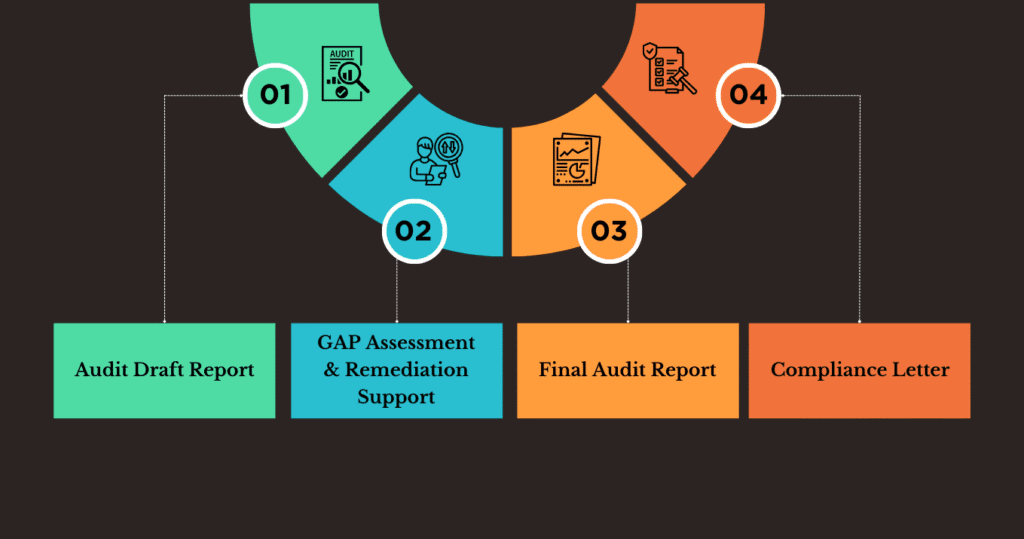
What You Receive from Our SAR Audit Engagement
When you choose Certcube Labs for your System Audit Report (SAR) compliance journey, you receive a complete, transparent, and regulator-ready package. Our deliverables are carefully structured to support your organization at every stage—from discovery to final compliance confirmation.
Key Benefits of SAR Compliance
Achieving SAR compliance is not just about meeting regulatory requirements—it’s a strategic move that strengthens your organization’s security, governance, and operational maturity. Here are the core benefits:
